

Block 26 Re-Entry
Industry-led solution to benefit all Syrians
Syria Re-Entry
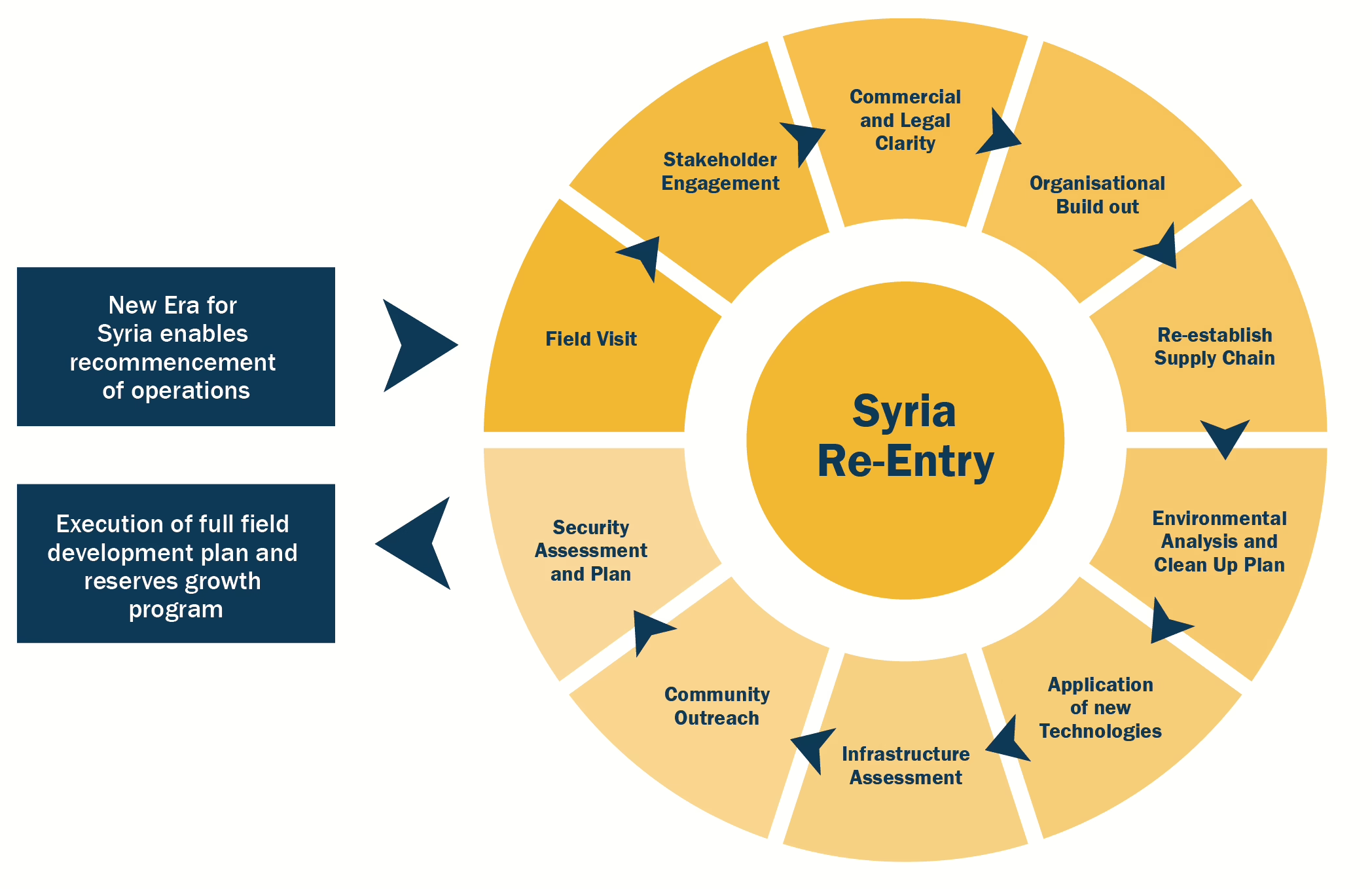
Following the widespread lifting of International sanctions on Syria in 2025, and SPC obtaining control and custody of oil fields in the North-East of Syria in early 2026, in accordance with the “30th January Agreement” between the Syrian Government and the SDF, Gulfsands has been able to begin the resumption of Block 26 operations, and the Joint Operating Company, Dijla, has been reconstituted.
Gulfsands intends to bring investment, expertise, human resources, and world-leading technologies and know-how to rehabilitate the fields, increase their production, and reduce environmental pollution. We anticipate that this will generate significant economic activity including jobs, training and commerce for the communities in which we operate.
Gulfsands’ technical team have undertaken a significant amount of technical work, formalising and analysing existing data, completing comprehensive technical studies of Block 26 to develop the existing discoveries, and define prospects/leads for nine high graded exploration wells to be drilled.
This has included the broad regional geology of North-East Syria, followed by interpretation of the 2011-reprocessed seismic data, and re-mapping existing Block 26 discoveries. Following which, static models have been constructed, reservoir facies have been modelled, and the results from studies undertaken on the seismic inversion data have been incorporated, with robust models built for use in dynamic modelling work. Based on the static models and available core and pressure, volume and temperature data, and production data from the fields, dynamic models have been initiated and matched for available pressure and production data. The history-matched models have then been used to forecast production profiles, along with a full field development plan.
Fields have been studied as a standalone basis first, then integrated together into one overall plan with a Central Processing Facility (“CPF”), and Gas Treatment Plant (“GTP”). Sensitivities have been done to optimize the processing capacity of the CPF and GTP.
Upon drilling the nine defined prospects and based on the exploration well results, the CPF and GTP capacity will again be optimised.
Production is currently through Early Production Facilities’ (“EPF”). The EPF is planned to be initially upgraded to increase liquid capacity, while the CPF will be considered and designed, taking into account increased production rates arising from the drilling campaign as per the FDP. Safety and environmental matters have been respected and considered in all FDP activities through all stages of the field life.
The above-mentioned studies have been subject to a Competent Persons Report (“CPR”) review by OPC as part of the re-entry preparation. The OPC review covered a comprehensive FDP of the existing discoveries as well as a comprehensive Exploration Programme for Prospective Resources within the exploration portfolio of nine prospects. The Board remains of the view that, as the CPR has indicated, that on a gross basis, Block 26 could contain over a billion barrels of recoverable resource.
As the Block 26 fields have not been operated in line with international standards for the last 14 years, several remedial activities are expected to be required early in the re-entry process; specifically to improve safety standards, the environment, improve operations, increase production, and the FDP will be reassessed. This will include:
Bringing the fields and employees to modern, standard environment, health and safety conditions.
Rehabilitate and upgrade the existing EPF.
Assuring reservoir and well data via production testing, reservoir and pressure monitoring and updating the reservoir studies accordingly.
Well intervention and workover activities.
Pilot project of new technologies.
Building the organisation of Dijla, including adopting procedures, systems and processes.
Build and develop procurement policies and procedures
Sustain logistics required for the implementation of the planned activities.
Several production enhancement technologies are being evaluated. These technologies will be tested in the early stage after re-entry, with the objective that Block 26 becomes a guiding example for production enhancement in Syria.
Stay Up to Date
Connect with us on LinkedIn and Twitter

