
Syria
The Group’s heritage and core assets are in the Syrian Arab Republic. Gulfsands main interest is in Block 26, a World Class resource in North-East Syria.
A new Dawn For Syria
Following the widespread lifting of international sanctions in 2025 and Syrian Petroleum Company regaining control and custody of oil fields in the North-East of Syria, Gulfsands has begun the process of recommencing Oil and Gas operations in Block 26 in H1 2026.
Learn More
Block 26 Re-Entry
Gulfsands’ core Syria strategy for many years has been to Protect and Preserve its rights related to Block 26 and to Prepare for a re-entry into Syria and a return to operations when circumstances allow. Gulfsands has begun the process of recommencing operations following over 14 years of Force Majeure.
Learn More
Syria – Block 26
Syria
Gulfsands is the Operator of the Block 26 Production Sharing Contract (“PSC”) and holds a 50% working interest in the PSC along with Sinochem Group (also 50% working interest).
Following the widespread lifting of international sanctions during 2025, and SPC obtaining control and custody of much of the North-East of Syria in early 2026, in accordance with the “30th January Agreement” between the Syrian Government and the SDF, SPC took control of the Khurbet East and Yousefieh producing fields in late February / early March 2026. This was closely followed by the visit of a senior delegation from SPC and Gulfsands to the fields on 10th March 2026. Extensive work has been undertaken to re-establish Dijla as the Joint Operating Company and an inaugural meeting of the reconstituted Board, attended by representative from SPC, Gulfsands and Sinochem, took place in Damascus on 23rd April 2026.
Block 26 Assets
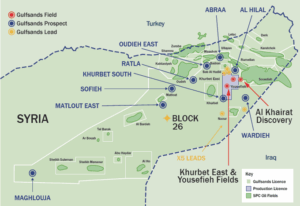
Block 26 is located in North-East Syria. The PSC grants to the Contractor Parties the exclusive right for the exploration, development and production in an area designated as “Block 26”. This includes the rights to the benefits of production from discovered fields for a minimum of 25 years from the date of initial commercial production from such development area, with an extension of a further ten years thereto at the partners’ option. Gulfsands’ joint venture partner in Block 26 is Sinochem Group, a Chinese conglomerate primarily engaged in the production and trading of chemicals and fertiliser, and exploration and production of oil.
Under the Group’s operatorship, two oil fields containing reservoirs of Cretaceous age have been discovered, appraised and approved for Development within the PSC area, Khurbet East (2008) and Yousefieh (2010). During 2011, combined production from these fields reached a level of just under 25,000 barrels of oil per day before the impact of EU/UK Sanctions resulted in the curtailing of production levels. Two additional oil and gas discoveries within reservoirs of Triassic age have been identified within the Kurrachine Dolomite and Butmah formations, beneath the Cretaceous aged oil producing reservoir in the Khurbet East field. Development approvals for these Triassic discoveries were granted in 2008 and 2011 respectively. A further oil discovery was made late in 2011 by Gulfsands in the Cretaceous aged reservoirs penetrated by the Al Khairat exploration well, a few kilometres east of the Yousefieh field. A Development Licence application for Al Khairat has been submitted in April 2026.
Operation of the Khurbet East and Yousefieh fields during the production phase has been undertaken by Dijla Petroleum Company (“Dijla”), a joint operating company formed between Gulfsands, Sinochem and Syrian state oil company, General Petroleum Corporation (“GPC”), for the purpose of undertaking the management and control of petroleum production operations and related infrastructure on Block 26. Staff of both Gulfsands and GPC were previously seconded to Dijla.
In October 2025, the new SPC was established, consolidating a range of Government entities involved in the Oil and gas industry. Among other matters, SPC assumed the functions and responsibilities of GPC in respect of the Block 26 PSC.
As a consequence of the EU’s imposition of further sanctions on Syria which came into effect in early December 2011, Force Majeure was declared by Gulfsands in respect of the Block 26 PSC. Since then, and until the reconstitution of the Dijla Board in early 2026, Gulfsands has had no involvement in petroleum production operations in Syria, although it maintained an office in Damascus to monitor the situation and ensure ongoing compliance with local laws and the PSC.
The recent developments in Syria, including widespread lifting of international sanctions throughout 2025, and the Syrian Government retaking control of the Khurbet East and Yousefieh producing fields in late February/early March 2026, have paved the way for a return to Development and Production operations in Block 26, and the reconstitution of Dijla. Under the terms of the PSC, Gulfsands expects that any time lost during the Force Majeure period, plus any time needed to remedy any damage done during the Force Majeure period will be added back to the term of the PSC and any related development or exploration periods.
Production
Since December 2011, Gulfsands has received periodic, infrequent/irregular updates from Dijla on hydrocarbon volumes produced from the Group’s Syrian fields under Dijla’s operation. In early 2017 the Company was informed by Dijla that the Group’s Syrian fields had returned to significant and regular production. The unauthorised production from the fields was described by GPC/Dijla as “stolen”. The Company has been unable to independently audit the precise production numbers from Dijla and was unable to visit the fields for several years due to an inability to get security clearance. In early-2026, SPC obtained custody and control of the Khurbet East and Yousefieh producing fields. In addition, Gulfsands General Manager in Syria, together with Dijla management, visited the fields for the first time in over 14 years.
The average production rate from all fields combined during 2025 appears to be around 12,700 boepd (though this tailed off during the year, and after year end, as oilfield practices further deteriorated) giving total unauthorised production during 2025 of around 4.6 million barrels of oil equivalent made up of 4.1 million barrels of oil and 3.4 Bcf of gas (2024: 5.1 million boe). Since the date of the first commercial oil production from the Block 26 area by the Group, cumulative oil production from the Group’s fields is understood to have exceeded 81.9 million boe by year end 2025 (End of 2024: 77.3 million barrels), of which around 63.29 million barrels (2024: 58.65 million barrels), have been produced since Force Majeure was declared, and without the involvement of Gulfsands. Gulfsands considers this production to be unauthorised, unlawful and breaches the Company’s contractual rights. The Group has not recognised or received any revenue for this or indeed any production, post the imposition of EU Sanctions (later UK). It has however, updated its remaining recoverable resource volumes for these fields, based on the production information.
Gulfsands plans to implement a comprehensive Field Development Plan which can increase production from these existing resources.
Exploration
At the time of the declaration of Force Majeure in December 2011, the PSC had nine months remaining of the final exploration period under the terms of the contract. Gulfsands has undertaken significant work during the period of Force Majeure to identify a portfolio of nine potential exploration prospects. Following the lifting of Force Majeure, Gulfsands plans to undertake an extensive exploration programme targeting these prospects. The Company believes it is well positioned to progress this significant exploration work programme and is in discussions with SPC to ensure that sufficient time will be made available for Gulfsands to undertake such a programme when it is secure and logistically possible to do so.
Strategy for Block 26
Block 26 could be proven to contain over a billion barrels of recoverable resource.
Gulfsands’ core Syria strategy is to Protect and Preserve its rights related to Block 26 and to a return to operations.
Gulfsands builds ESG and sustainability considerations into all its re-entry planning, as well as maintaining compliance with all local laws to protect its rights under its PSC.
The Board believes, and an independant Competent Persons Report (“CPR”) has confirmed, that upon re-entry, on a gross basis, Block 26 could be proven to contain over a billion barrels of recoverable resource with the potential for production levels of around 50,000 boepd from existing discoveries in the near term, and over 100,000 boepd from a full block development incorporating the potential exploration upside.
Stay Up to Date
Connect with us on LinkedIn and Twitter

